


Housekeeping Gene Selection in Mesenchymal Stem Cells: Challenges, Variability, and Standardization Strategies

- VNUHCM-US Stem Cell Institute, University of Science, Ho Chi Minh City, Vietnam
- Vietnam National University Ho Chi Minh City, Ho Chi Minh City, Vietnam
Abstract
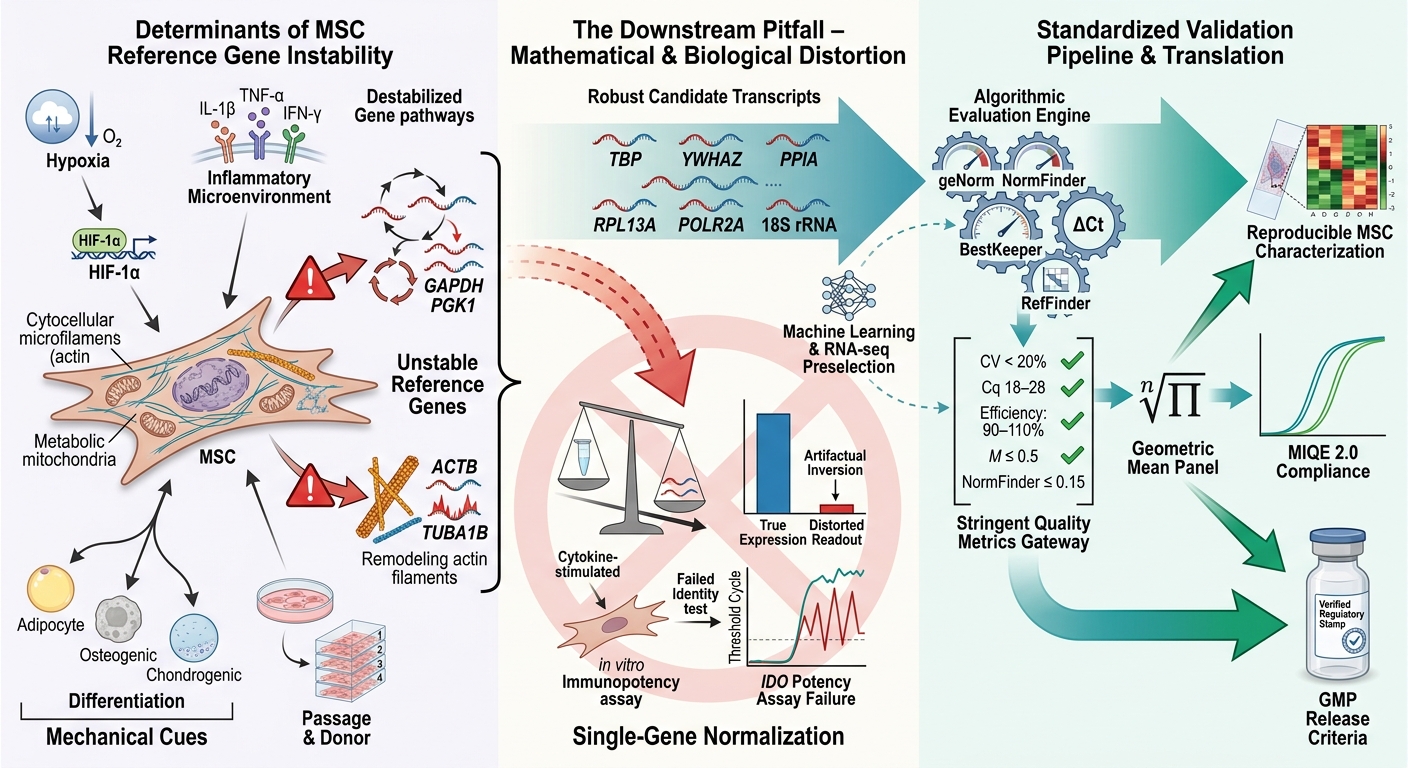
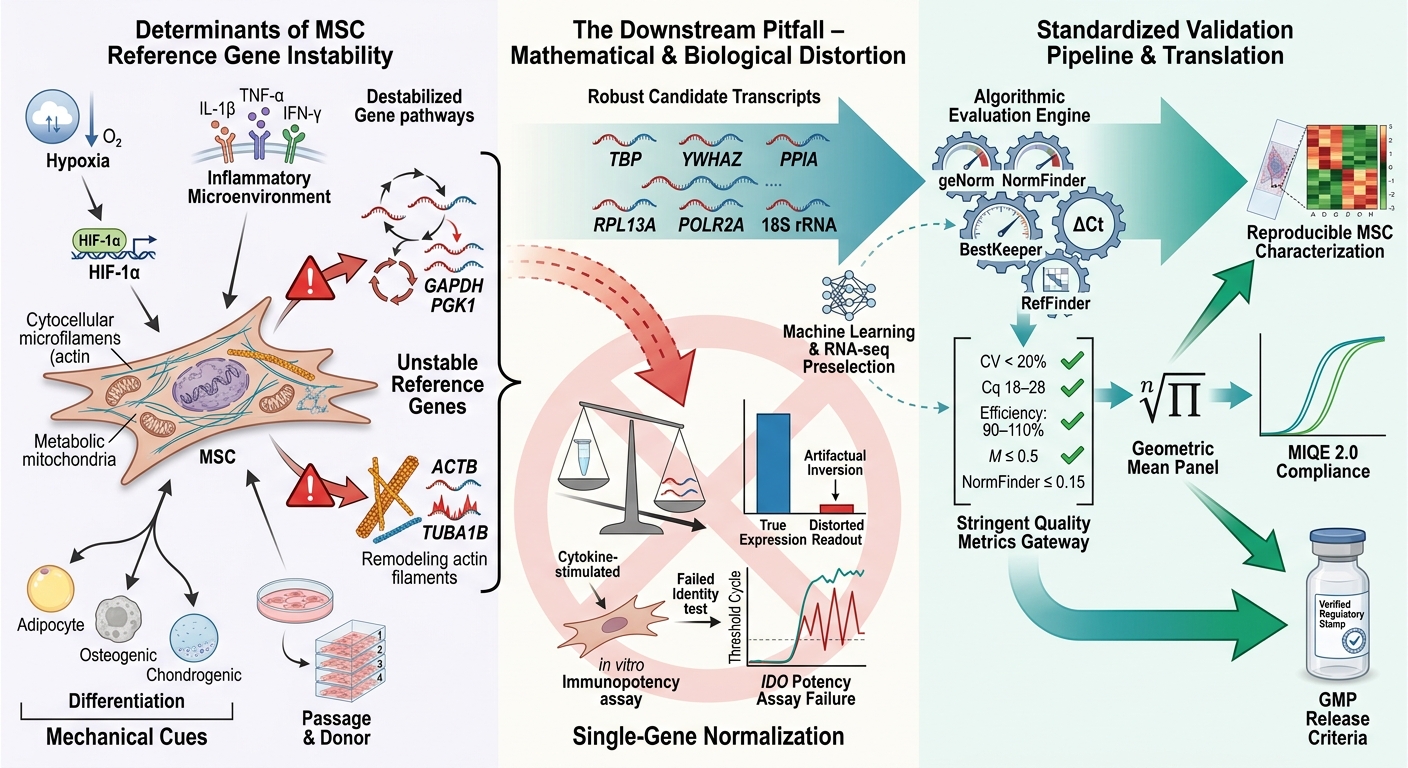
Housekeeping genes (HKGs) serve as essential internal controls for transcript normalization in quantitative gene expression analyses, predominantly reverse transcription quantitative real-time PCR (RT-qPCR) and RNA sequencing (RNA-seq). In mesenchymal stem/stromal cell (MSC) research, conventional HKGs—such as glyceraldehyde-3-phosphate dehydrogenase (GAPDH), beta-actin (ACTB), 18S ribosomal RNA (18S rRNA), and hypoxanthine phosphoribosyltransferase 1 (HPRT1)—have historically been presumed to be constitutively and stably expressed across diverse experimental conditions. However, accumulating empirical evidence reveals that their transcript abundance fluctuates markedly according to tissue origin, donor demographics, in vitro passage number, culture confluency, differentiation status, and external microenvironmental stimuli. Such uncharacterized expression instability invalidates numerical normalization, distorts relative target quantification, and introduces substantial reproducibility challenges into both fundamental cell biology and translational MSC investigations. This comprehensive review synthesizes current insights into the biological mechanisms driving HKG transcriptional instability in MSCs across diverse experimental settings, including osteogenic, adipogenic, and chondrogenic differentiation, hypoxic culture, inflammatory priming, and mechanical stimulation. We critically compare standard algorithmic frameworks for reference gene selection—including geNorm, NormFinder, BestKeeper, the comparative ΔCt method, and RefFinder—and highlight candidate reference genes displaying superior empirical stability (e.g., TBP, RPL13A, YWHAZ, and PPIA). Furthermore, we examine emerging paradigms, including the use of small non-coding RNAs for extracellular vesicle characterization, machine learning–based predictive modeling, and the formulation of standardized reference panels for clinical-grade MSC biomanufacturing under Good Manufacturing Practice (GMP) compliance. Finally, we formulate practical, evidence-based recommendations aligned with the updated Minimum Information for Publication of Quantitative Real-Time PCR Experiments (MIQE 2.0) guidelines to guide rigorous reference gene validation, ensuring the validity, reproducibility, and therapeutic translatability of MSC gene expression data.
Graphical abstract
Introduction
Housekeeping genes (HKGs) serve as foundational internal standards for normalizing gene expression profiles in quantitative molecular profiling assays, most notably reverse transcription quantitative real-time polymerase chain reaction (RT-qPCR) and RNA sequencing (RNA-seq)1,2. Accurate transcript normalization remains indispensable for mitigating confounding technical variability introduced by fluctuations in initial RNA yield, RNA integrity, enzymatic reverse transcription efficiency, and exponential PCR amplification kinetics2,3. Historically, classical reference transcripts—such as glyceraldehyde-3-phosphate dehydrogenase (GAPDH), beta-actin (ACTB), 18S ribosomal RNA (18S rRNA), and hypoxanthine phosphoribosyltransferase 1 (HPRT1)—were widely assumed to be constitutively and uniformly expressed across distinct cell lineages, leading to their routine application without prior experimental validation1,4.
Mesenchymal stem/stromal cells (MSCs) have emerged as an essential platform in regenerative medicine, immunomodulatory therapy, and tissue engineering, underpinning extensive preclinical investigations and clinical trials5. MSCs can be isolated from a diverse spectrum of anatomical sources, including bone marrow, adipose tissue, umbilical cord matrix, placenta, and other perinatal tissues, with each compartment imparting distinct biological, phenotypic, and transcriptomic properties5,6,7,8,9. This pronounced innate heterogeneity, compounded by the extensive in vitro ex vivo expansion required to generate clinically meaningful cell dosages, poses substantial hurdles for standard transcript normalization strategies10,11.
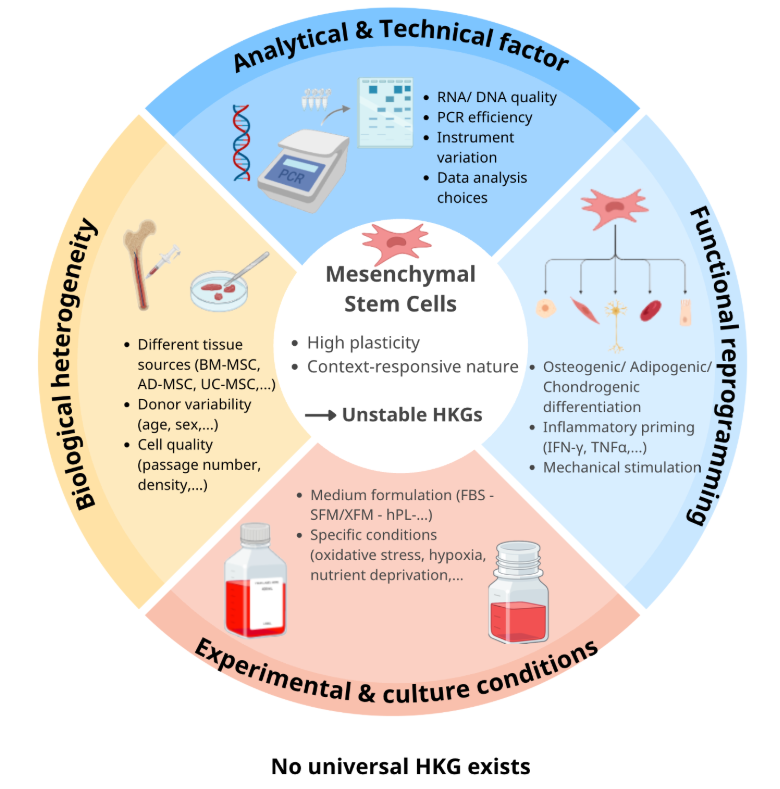
A burgeoning body of empirical evidence underscores that the transcript abundance of conventional HKGs in MSCs is exquisitely sensitive to culture context. Factors including anatomical tissue derivation, inter-donor variability, cumulative passage number, cellular seeding density, multilineage differentiation commitment, ambient hypoxia, inflammatory activation, and mechanical loading have all been shown to disrupt HKG expression stability12,13. Crucially, classical reference genes such as GAPDH and ACTB actively participate in core glycolytic and cytoskeletal networks, rendering their transcription highly vulnerable to common experimental perturbations14. Consequently, the uncritical adoption of single unvalidated HKGs in MSC research has frequently precipitated flawed normalization, compromised data reproducibility, and yielded contradictory biological interpretations15 (Figure 1).
Multifactorial determinants of reference gene stability in mesenchymal stem/stromal cells (MSCs). This diagram illustrates the extrinsic and intrinsic variables that undermine the transcriptional stability of traditional housekeeping genes (HKGs) in mesenchymal stem/stromal cells (MSCs). The central core highlights the hallmark properties of MSCs—namely, their high cellular plasticity and context-responsive transcriptome—which inherently predispose candidate HKGs to transcriptional fluctuations and demonstrate that no universal reference gene exists. These perturbations are categorized into four major interconnected quadrants: Biological Heterogeneity: Variations driven by diverse anatomical tissue sources (e.g., BM-MSC, AD-MSC, UC-MSC), donor demographics (e.g., chronological age, biological sex, underlying clinical pathologies), and cellular expansion quality (e.g., cumulative in vitro passage number, seeding density, replicative senescence). Functional Reprogramming: Dynamic transcriptional shifts induced during trilineage commitment (osteogenic, adipogenic, and chondrogenic differentiation), inflammatory priming (e.g., licensing with IFN-γ, TNF-α, or IL-1β), and mechanical cues (e.g., tensile stretching, shear stress, substrate stiffness, and 3D architectural constraints). Experimental & Culture Conditions: Microenvironmental influences originating from basal media formulations (e.g., fetal bovine serum [FBS] vs. serum-free [SFM], xeno-free [XFM], or human platelet lysate [hPL] supplementation) and specific physicochemical stress factors (e.g., oxidative stress, pericellular hypoxia [<1% O2], and nutrient deprivation). Analytical & Technical Factors: Methodological and pre-analytical confounders that introduce technical variance, including RNA extraction purity, RNA integrity number (RIN), reverse transcription enzymatic efficiency, real-time PCR amplification efficiency, inter-instrument detection variance, and quantitative data analysis algorithms. Abbreviations:AD-MSC: adipose-derived mesenchymal stem cell; BM-MSC: bone marrow–derived mesenchymal stem cell; FBS: fetal bovine serum; HKG: housekeeping gene; hPL: human platelet lysate; IFN-γ: interferon gamma; PCR: polymerase chain reaction; SFM: serum-free medium; TNF-α: tumor necrosis factor alpha; UC-MSC: umbilical cord–derived mesenchymal stem cell; XFM: xeno-free medium.
The ramifications of reference gene instability are particularly acute in translational and clinical manufacturing settings. Clinical MSC therapies demand extensive ex vivo expansion to attain targeted therapeutic doses, an intervention inextricably linked to replicative senescence, profound cytoskeletal remodeling, and genome-wide transcriptomic rewiring16. Furthermore, the regulatory transition from fetal bovine serum (FBS)-supplemented culture media toward chemically defined serum-free (SFM) or xeno-free (XFM) formulations—mandated by Good Manufacturing Practice (GMP) compliance—imposes additional transcriptional shifts that profoundly alter baseline HKG stability13. In these bioprocessing environments, selecting an inappropriate reference gene can introduce false readouts in quantitative potency assays, distorting the perceived efficacy and release criteria of critical immunomodulatory and differentiation pathways13,16.
To address these limitations, a variety of statistical and computational validation frameworks have been established, including geNorm, NormFinder, and BestKeeper, alongside integrated consensus tools such as RefFinder17,18. Because reference gene stability is inherently context-dependent, no single universal HKG can perform reliably across all MSC experimental conditions13. Instead, genes participating in basal transcription initiation or proteostatic turnover—such as TATA-box binding protein (TBP), ribosomal protein L13a (RPL13A), peptidylprolyl isomerase A (PPIA), and tyrosine 3-monooxygenase/tryptophan 5-monooxygenase activation protein zeta (YWHAZ)—frequently demonstrate superior stability within tailored biological contexts19,20,21. In recent years, these accumulated insights have catalyzed a fundamental paradigm shift toward multi-gene normalization strategies and rigorous pre-validation, principles formally codified in the updated Minimum Information for Publication of Quantitative Real-Time PCR Experiments (MIQE 2.0) guidelines22.
This narrative review synthesizes contemporary experimental and computational findings examining HKG expression variability in MSCs across diverse biological and technical landscapes, including multilineage differentiation, hypoxia, inflammatory priming, mechanical stimulation, and GMP-compliant biomanufacturing. We critically evaluate established validation algorithms, explore emerging frontiers—such as RNA-seq–assisted candidate preselection, small non-coding RNA normalization, and machine learning–driven discovery models15—and provide a structured series of practical recommendations to maximize experimental validity, methodological reproducibility, and translational reliability in MSC gene expression profiling.
This narrative review was informed by a systematic literature search conducted across PubMed, Web of Science, and Google Scholar, capturing peer-reviewed studies published up to 2025. Search strings incorporated combinations of the following terms: "mesenchymal stem cells", "mesenchymal stromal cells", "housekeeping genes", "reference genes", "gene expression normalization", "RT-qPCR", "RNA-seq", "hypoxia", "multilineage differentiation", "inflammatory priming", "serum-free media", "xeno-free culture", and "GMP biomanufacturing". Articles evaluating reference gene stability in MSCs under defined biological or physical perturbations were critically appraised. Given the broad methodological diversity across MSC sources and experimental systems, findings were qualitatively synthesized and structured thematically by experimental context. Representative empirical studies were prioritized to illustrate recurrent patterns of transcript stability and instability rather than to provide an exhaustive enumeration.
Concept of Housekeeping Genes in the Context of Mesenchymal Stem Cell Biology
Classical molecular biology traditionally defines housekeeping genes as an essential cohort of constitutively expressed genes required for basal cellular maintenance, encompassing central metabolic processing, cytoskeletal integrity, ribosome biogenesis, and basic transcriptional upkeep23. Historically, these genes were assumed to exhibit uniform transcription across diverse cell lineages and physiological states, independent of external conditions23. However, modern high-throughput transcriptomic profiling and rigorous empirical validation have revealed this paradigm to be fundamentally oversimplified. Even under baseline homeostatic conditions, conventional candidate HKGs display notable transcriptional fluctuations across distinct cell types, developmental stages, and microenvironmental niches, undermining their validity as invariant internal standards23. Consequently, candidate reference genes must no longer be viewed as absolute constants, but rather as empirical candidates whose expression stability must be experimentally verified in each specific biological system10.
This conceptual limitation is uniquely pronounced in MSCs. Beyond their characteristic trilineage differentiation capacity, MSCs possess exceptional phenotypic plasticity and environmental sensitivity. During osteogenic, adipogenic, and chondrogenic differentiation, MSCs undergo sweeping transcriptional reprogramming that reconfigures wide functional networks rather than merely altering isolated lineage markers24,25. These lineage specifications are intrinsically coupled to extensive metabolic transitions, such as switching from aerobic glycolysis to mitochondrial oxidative phosphorylation (or vice versa), which causally drives the upregulation or downregulation of metabolic genes routinely employed as reference standards24,25. Furthermore, culturing MSCs under physiological or pathophysiological hypoxia—frequently utilized to sustain stemness, promote expansion, or mimic the native in vivo niche—stabilizes hypoxia-inducible factor 1-alpha (HIF-1α) and transactivates glycolytic target genes, triggering substantial expression shifts in metabolic HKGs such as GAPDH and PGK126.
In addition to metabolic rewiring, MSCs mounting immunomodulatory responses exhibit pronounced transcriptional plasticity. Exposure to proinflammatory cytokines, such as interferon-gamma (IFN-γ) or tumor necrosis factor-alpha (TNF-α), initiates broad stress-responsive and immune-regulatory cascades27,28. Concurrently, biophysical cues—such as substrate stiffness, cyclic tensile stretch, and three-dimensional (3D) scaffold architecture—activate cytoplasmic mechanotransduction pathways and induce extensive cytoskeletal remodeling28,29. Because structural genes such as ACTB and TUBA1B are central components of the actin and microtubule machinery, their transcription fluctuates dynamically during physical perturbation. Moreover, baseline transcriptomic heterogeneity stemming from donor demographics, tissue origin, and isolation procedures introduces substantial inter-donor variability even prior to experimental stimulation27.
Collectively, these unique attributes position MSCs as a biologically sensitive system in which subtle experimental perturbations elicit pronounced transcriptional responses. Secondary variables that exert minimal impact on immortalized cell lines—such as subculture passage number, cell confluency, pericellular oxygen tension, and basal medium formulation—profoundly modulate the MSC transcriptome10,27. From a conceptual standpoint, reference gene stability in MSC models cannot be assumed a priori but must be rigorously demonstrated within each designated experimental framework.
Mechanistic insight into reference gene instability can be obtained by examining the functional roles of candidate genes within MSC biology. Instability is rarely a stochastic phenomenon; rather, it directly mirrors the functional involvement of candidate genes in the cellular pathways undergoing experimental remodeling26,30. Cytoskeletal genes (e.g., ACTB, TUBA1B) fluctuate extensively because actin dynamics and cell morphology are tightly linked to lineage commitment and mechanotransduction28,29. Ribosomal protein genes (e.g., RPL13A, RPLP0) frequently exhibit robust stability under moderate conditions but can drift significantly in response to altered proliferation rates, fluctuating translational demand, or metabolic stress31. Transcripts involved in basal transcriptional initiation (e.g., TBP, POLR2A) generally display superior stability because they regulate global RNA polymerase II assembly rather than stimulus-specific responses4,30. Similarly, molecular chaperones and proteostatic regulators (e.g., PPIA, HSP90AA1, UBC) often maintain stable expression during standard expansion and mild physical stimulation, although they may fluctuate under severe cellular stress, proteasomal saturation, or replicative senescence32,33.
This biological interconnectedness introduces a major hazard in reference gene selection: functional co-regulation. Evaluating multiple candidate genes belonging to identical metabolic or structural pathways can yield artificially low pairwise variation scores, generating misleadingly stable normalization factors that merely mirror shared biological regulation. As detailed in Table 1, candidate panels must deliberately integrate genes from disparate, non-overlapping functional categories. Given the intrinsic plasticity of MSCs, an ideal reference gene represents an operational definition rather than a universal transcript. Endogenous reference controls should possess low intra- and inter-group transcriptional variance, moderate baseline expression (avoiding extreme saturation or low-abundance dropout), consistent amplification efficiency (90–110%), and no mechanistic involvement in the experimental conditions under study. Because no single gene completely fulfills these criteria across all MSC platforms, contemporary consensus strongly advocates a multi-gene normalization paradigm: screening a diverse set of candidate genes and applying the geometric mean of two or three validated, stably expressed transcripts (e.g., TBP, RPL13A, PPIA, YWHAZ) (Table 1).
Functional classification, biological roles, and context-dependent stability of candidate reference genes in mesenchymal stem cells.
| Functional Category | Candidate Gene Symbols | Biological Roles, Stability Factors, and Contextual Risk Considerations |
|---|---|---|
| Cytoskeletal | Encodes core structural microfilaments and microtubules. Heavily altered during osteogenic/adipogenic differentiation, mechanical loading, cell passaging, and donor variation. Frequently identified as the least stable reference gene in MSCs (poor geNorm ranking; highly unstable under extensive expansion or inflammatory priming) | |
| Metabolic | Directly involved in the glycolytic energy cascade. Strongly influenced by pericellular hypoxia, glucose fluctuations, inflammatory activation, and nutrient starvation. Markedly unstable in adult MSCs (BMSCs and ASCs), although relatively more stable in neonatal hAMSCs; displays significant expression shifts during early tenogenic commitment | |
| Ribosomal | Structural constituents of the 60S ribosomal subunit mediating protein synthesis. Generally stable across multiple standard culture conditions; achieves optimal stability when combined with | |
| Regulatory / Signaling | Participates in basal transcriptional assembly ( | |
| RNA Polymerase / Basal Transcription | Encodes the largest catalytic subunit of RNA polymerase II ( | |
| Protein Folding / Molecular Chaperones | Catalyzes cis-trans isomerization of proline peptide bonds ( | |
| Ubiquitin-Proteasome Pathway | Encodes polyubiquitin precursors essential for proteasome-mediated protein degradation and cellular homeostasis. |
Factors Influencing the Variability of Housekeeping Genes in MSCs
Culture Environment and Bioprocessing Conditions
Extrinsic culture parameters exert a profound influence on MSC gene expression profiles7. Because MSCs dynamically adapt to their in vitro niche, candidate reference genes must maintain transcriptional stability across diverse tissue sources (bone marrow, adipose tissue, umbilical cord matrix, placenta), long-term passaging (passages 2 to 10+), multilineage differentiation, physiological hypoxia, proinflammatory challenge, 3D scaffold encapsulation, and cellular senescence8,10,34.
The metabolic sensitivity of MSCs represents a primary driver of HKG variability. MSCs toggle between glycolytic flux and oxidative phosphorylation in response to pericellular oxygen levels and nutrient availability. Hypoxic culture—widely employed to maintain naive stemness or replicate physiological stem cell niches—stabilizes HIF-1α, which directly transactivates glycolytic enzymes, including GAPDH26. Consequently, GAPDH transcript abundance rises substantially under hypoxia, invalidating its utility as a reference gene in low-oxygen studies. Similarly, exposure to inflammatory mediators (e.g., IFN-γ, TNF-α, IL-1β) and physical stimuli (e.g., fluid shear stress, scaffold stiffness, 3D encapsulation) activates broad immunomodulatory and mechanosensitive cascades that profoundly dysregulate structural genes such as ACTB28.
Biomanufacturing parameters—including media supplementation, cell seeding density, passage number, and oxidative stress—introduce additional layers of variability. A seminal study by Ragni et al. (2024) demonstrated pronounced differences in HKG stability when adipose-derived stem cells (AD-MSCs) were transitioned from standard FBS-containing media to clinical-grade SFM or XFM formulations13. Similarly, Fitzgerald et al. (2023) highlighted the decisive impact of medium composition on MSC phenotypic stability, observing that XFM systems reduced inter-donor and batch-to-batch transcriptomic variability compared to undefined FBS-supplemented cultures35. Chemically defined and serum-free platforms eliminate the uncharacterized growth factors and microvesicles inherent to FBS, thereby providing a more consistent transcriptional baseline36. Aussel et al. (2022) corroborated this finding, demonstrating reduced HKG variability in FBS-free expansion protocols designed for clinical-grade MSC manufacturing37.
Crucially, media formulations alter the relative stability hierarchy of individual HKGs. For example, in AD-MSCs, EF1A exhibited high stability in FBS-supplemented cultures, whereas GAPDH demonstrated superior stability in specific xeno-free media, and TBP remained consistently robust across all tested formulations13. These findings indicate that distinct media compositions imprint unique transcriptomic signatures on MSCs. Consequently, early and integrated reference gene validation must be incorporated into standard quality control (QC) protocols and institutional standard operating procedures (SOPs) for GMP-compliant cell therapy biomanufacturing.
In addition to biochemical factors, mechanical loading forces play a decisive role in regulating MSC fate. Dynamic compressive, tensile, or shear stresses trigger mechanotransductive signaling through integrins and focal adhesion complexes, inducing major cytoskeletal rearrangements and destabilizing cytoskeleton-associated reference transcripts29.
Biological Heterogeneity and Tissue-Source Specificity
MSCs exhibit profound phenotypic plasticity, undergoing extensive transcriptomic reprogramming during osteogenic, adipogenic, and chondrogenic differentiation24,25. These lineage commitment processes systematically alter basal cellular metabolism and structural architecture, directly impacting candidate reference genes.
MSCs isolated from distinct anatomical niches (e.g., bone marrow, adipose tissue, umbilical cord, dental pulp) display distinct baseline transcriptional signatures, contributing to significant variability in HKG performance9. Calcat-i-Cervera et al. (2023) demonstrated that under harmonized culture conditions, bone marrow MSCs (BM-MSCs) exhibited substantial inter-donor variability, adipose-derived MSCs displayed the greatest consistency, and umbilical cord MSCs (UC-MSCs) showed attenuated differentiation responsiveness38. Furthermore, donor demographics—such as age, sex, and health status—strongly dictate reference gene stability; adult MSCs exhibit divergent HKG expression compared to fetal or neonatal counterparts10. Notably, the disruptive effect of HKG variability is more pronounced when analyzing individual donors than when evaluating pooled or averaged datasets10.
In accordance with International Society for Cell & Gene Therapy (ISCT) criteria, MSC identity requires demonstrable multipotent trilineage differentiation39. However, lineage specification triggers functional reprogramming that directly perturbs candidate reference transcripts. Osteogenic and adipogenic inductions induce a metabolic shift from glycolysis toward mitochondrial oxidative phosphorylation40. Luque-Campos et al. (2021) demonstrated that this metabolic reprogramming not only governs MSC differentiation and macrophage-polarizing capability but also causes significant fluctuations in glycolytic transcripts such as GAPDH41. Simultaneously, morphological reshaping during osteogenesis alters actin microfilament dynamics, directly driving the downregulation or instability of ACTB34. Thus, both metabolic and structural remodeling during differentiation actively destabilize classical HKGs.
Temporal Dynamics and Microenvironmental Perturbations
Beyond culture media and tissue origins, subculture passage number and cell density significantly dictate reference gene stability. Greer et al. (2010) established that cell seeding density markedly modulates HKG transcript abundance42. Extended in vitro passaging drives MSCs into replicative senescence, characterized by permanent cell-cycle arrest, enlarged flattened morphology, cytoskeletal reorganization, and widespread transcriptional senescence-associated secretory phenotype (SASP) expression. Low-density cultures favor rapid self-renewal and stemness marker expression, whereas high confluence triggers contact inhibition, cell-cycle withdrawal, and altered HKG expression. These temporal parameters must be rigorously standardized during experimental setup.
Under specific stress conditions, reference gene instability becomes acute. Ong et al. (2023) demonstrated that in human AD-MSCs subjected to hypoxia, GAPDH and PGK1 are entirely unsuitable for normalization due to the presence of functional hypoxia response elements (HREs) in their promoter regions; conversely, 18S rRNA and RRP1 maintained remarkable stability43. Rahimi et al. (2021) further documented that oxidative stress generated during MSC isolation, passaging, or cryopreservation alters secretome dynamics and induces severe fluctuations in HKG expression44.
To simulate in vivo pathophysiological niches, researchers frequently treat MSCs with inflammatory cytokines, growth factors, or biophysical forces (Table 1). Wiese et al. (2022) revealed that stimulation with TNF-α, IL-1β, or IFN-γ markedly alters MSC global gene expression relative to unprimed controls45. In contrast, Valencia et al. (2025) reported that short-term proinflammatory cytokine priming enhances immunomodulatory capacity (e.g., suppressing T-cell and NK-cell proliferation, attenuating dendritic cell activation, and promoting M2-like macrophage differentiation) without compromising core immunophenotypes or trilineage differentiation46. The divergent transcriptional impacts observed between these studies stem from differences in cytokine concentrations, exposure kinetics, and basal culture status, highlighting the decisive role of experimental design. Furthermore, mechanical cues such as cyclic tensile stretch, fluid shear, and matrix stiffness trigger RhoA/ROCK signaling and actin filament bundling, leading to marked shifts in ACTB transcription. Consequently, ACTB should be strictly avoided in mechanobiology studies involving bioreactors or stiffness-tuned scaffolds.
These cumulative observations emphasize that candidate HKGs must be experimentally screened and validated for each specific experimental model rather than adopted by convention (Table 2). In MSC systems, GAPDH and ACTB frequently rank among the most unstable transcripts (Table 1), reflecting their central positions in glycolysis and cytoskeletal dynamics. Crucially, Ragni et al. (2024) observed that even under standard FBS-supplemented culture, GAPDH displayed severe expression instability48, debunking the assumption of its universal utility. While reference gene stability remains donor- and context-dependent, avoiding GAPDH and ACTB as default normalization controls—particularly in adult MSCs subjected to differentiation, hypoxia, or cytokine challenge—represents a necessary methodological improvement.
Summary of representative empirical studies evaluating reference gene variability in mesenchymal stem cells across defined experimental conditions.
| Cell Type & Condition | Experimental Model & Mechanism | Biological & Transcriptomic Impact | Unstable HKGs | Stable Alternatives | Reference |
|---|---|---|---|---|---|
|
Gingival MSCs Oxidative stress | Exposure to high ambient glucose concentrations (25–30 mM) | Alters glycolysis, elevates intracellular ROS, and modulates apoptotic pathways | 18S rRNA | Junaid et al., 2021 | |
|
AD-MSCs Serum starvation | Cell culture in basal DMEM without FBS supplementation | Suppresses cell cycle progression, induces quiescence, and initiates cytoskeletal remodeling | Ragni et al., 2024 | ||
|
AD-MSCs Serum-free / Xeno-free media | Culture in chemically defined media without animal serum or xenogeneic additives | Modulates integrin-mediated adhesion, membrane trafficking, and translation rate | Ragni et al., 2024 | ||
|
AD-MSCs Hypoxic culture | Incubation under normoxia (21% O2) vs. physiological/severe hypoxia (<1% O2) | Stabilizes HIF-1α signaling, upregulating glycolytic target genes containing HREs | 18S rRNA, | Ong et al., 2023 | |
|
AD-MSCs Inflammatory stimulation | Basal medium supplemented with IL-1β or TNF-α | Activates NF-κB signaling and induces inflammatory and cytoskeletal restructuring | Ragni et al., 2024 | ||
|
MSCs Electrical stimulation | Application of a direct-current electric field (100 mV/mm) | Alters cell polarization, cytoskeletal alignment, and intracellular calcium mobilization | Steel et al., 2022 | ||
|
hBM-MSCs Osteogenic differentiation | Osteogenic cocktail (0.2 mM ascorbic acid, 10 mM β-glycerophosphate, 100 nM dexamethasone) | Dynamic transcriptional lineage commitment, mineralization, and cell morphology changes | Quiroz et al., 2010 | ||
|
BMSCs / ASCs Tenogenic differentiation | Medium supplemented with BMP-12, ascorbic acid, and basic fibroblast growth factor | Stimulates tenogenic transcription factors ( | Viganò et al., 2018 | ||
|
Cross-source baseline (AD-, BM-, UC-MSCs) | Unstimulated baseline conditions across distinct anatomical tissue derivations | Inherent epigenetic and metabolic divergence governed by tissue ontogeny | Li et al., 2015 | ||
|
Adult MSCs (ADSC, BM-MSC, hAMSC) | Comparison of adult donor cohorts across increasing age ranges | Age-related senescence shifts, reduced proliferative capacity, and metabolic decline | Ragni et al., 2024 | ||
| Fetal vs. Neonatal MSCs | Ontogenetic comparison of developmental stages (placental/umbilical vs. adult) | Disparate baseline cell division rates and global transcriptional activity | Ragni et al., 2024 | ||
|
AD-MSCs Proliferation & differentiation | Logarithmic growth phase vs. multidirectional lineage specification | Dynamic reconfiguration of metabolic, ribosomal, and structural gene networks | Ayanoğlu et al., 2020 | ||
|
AD-MSCs FBS-containing medium | Standard expansion in 10% FBS-supplemented basal medium | Heterogeneous serum growth factors stimulate cell motility and basal glycolysis | Ragni et al., 2024 | ||
|
BM-MSCs culture + inflammation | Hydrogel/scaffold 3D encapsulation combined with TNF-α or IFN-γ priming | Synergistic biophysical confinement and cytokine-induced cytoskeletal tension | Gonzalez-Pujana et al., 2020 | ||
|
UC-MSCs Lentiviral transduction + diff. | Lentiviral gene transfer followed by trilineage differentiation induction | Cellular defense response to vector integration coupled with lineage remodeling | Borkowska et al., 2020 |
Quantitative benchmarks for validating candidate HKGs in MSC models include: low statistical variance (coefficient of variation [CV] < 20%, geNorm stability measure M ≤ 0.5, NormFinder stability value ≤ 0.15), moderate transcript abundance (quantification cycle [C] values between 18 and 28), robust amplification efficiency (90–110%), and verified absence of functional participation in the pathways under investigation7,52. Because MSCs exhibit pronounced donor and tissue heterogeneity and undergo replicative senescence during prolonged culture, no universal reference gene exists across all MSC paradigms7,8,10,34. Current international guidelines therefore recommend screening 8–12 candidate genes (e.g., RPL13A, PPIA, TBP, HPRT1, YWHAZ) across representative experimental samples and utilizing the geometric mean of the top 2–3 validated genes for accurate normalization (Table 3)1,31,53.
Comparative evaluation of mathematical algorithms and software tools for reference gene stability analysis.
| Evaluation Dimension | geNorm | NormFinder | BestKeeper | Comparative ΔCt Method | RefFinder |
|---|---|---|---|---|---|
| Mathematical Principle | Calculates the pairwise variation of each candidate gene against all others, defining stability measure | Employs an ANOVA-based model to evaluate expression variance, partitioning variance into intra-group (within a condition) and inter-group (across conditions) components to yield a direct stability value ( | Evaluates candidate gene stability using raw Ct values through descriptive statistics (SD, CV) and pairwise Pearson correlation coefficients ( | Performs pairwise comparisons of relative cycle threshold differences (ΔCt) between all candidate gene pairs within each sample; ranks stability based on mean ΔCt standard deviations across samples. | Integrative web-based algorithm that calculates the geometric mean of candidate gene ranking positions generated across geNorm, NormFinder, BestKeeper, and the comparative ΔCt method. |
| Input Data Format | Relative linear quantities ( | Linear relative quantities (same format as geNorm), with optional sample group annotations. | Raw, untransformed cycle threshold (Ct/Cq) values and assay-specific amplification efficiencies. | Raw or normalized cycle threshold (Ct/Cq) values. | Raw Ct values or individual stability ranks generated by the four primary algorithms. |
| Stability Metric & Interpretive Threshold |
| Stability value ( |
CV < 2–5%: acceptable variance | Lowest mean standard deviation ( | Comprehensive ranking based on the geometric mean of individual algorithm ranks; convergence across algorithms indicates high confidence. |
| Ease of Implementation | ++ | + | ++ | ++ | ++ |
| Quantitative Stability Ranking | ++ | ++ | + | + | ++ |
| Statistical Robustness | + | ++ | + | – | + |
| Resistance to Co-Regulation Bias | – (high vulnerability due to pairwise correlation) | ++ (robust against co-regulation via ANOVA modeling) | – (vulnerable to correlated expression shifts) | – (vulnerable to pairwise co-regulation) | + (partially buffered by multi-method aggregation) |
| Performance in Heterogeneous Cohorts | – (assumes constant expression ratios) | ++ (models inter-group and intra-group variance separately) | – (confounded by biological subgroup shifts) | – (sensitive to subgroup sample variance) | + (reflects composite performance across tools) |
Methodological Frameworks and Algorithms for Evaluating Reference Gene Stability
To quantify reference gene stability rigorously, researchers employ an array of statistical algorithms alongside high-throughput transcriptomic profiling tools (RT-qPCR, RNA-seq, and microarrays). For instance, Ong et al. (2023) established an RNA-seq-guided selection pipeline in human AD-MSCs: candidate genes from literature databases were cross-referenced against whole-transcriptome RNA-seq profiles of normoxic and hypoxic cells. Candidates exhibiting minimal biological variance (low CV and log fold-change near zero) were shortlisted, validated by RT-qPCR, and evaluated using geNorm, NormFinder, and BestKeeper to pinpoint the most resilient reference set43.
Algorithmic platforms such as geNorm, NormFinder, and BestKeeper assess relative stability by evaluating candidate gene expression across experimental cohorts (Table 2). To streamline multi-algorithm comparisons, RefFinder integrates geNorm, NormFinder, BestKeeper, and the comparative ΔC method into a unified web-accessible platform17. RefFinder assigns an overall stability ranking based on the geometric mean of the individual algorithm ranks, thereby minimizing single-method bias. Nevertheless, RefFinder possesses intrinsic constraints: it lacks customizable weighting parameters, cannot perform advanced multivariate modeling, handles large-scale genomic datasets slowly, and its consensus metric may obscure nuanced, context-dependent variances.
An enhanced geNorm module has been incorporated into Biogazelle's qbase+ analytical software suite54. Compared to the original macro-based geNorm program, qbase+ offers accelerated processing speeds, automated QC reporting, robust handling of missing values, identification of the single most stable reference transcript (rather than only the final stable gene pair), and cross-platform compatibility across Windows, macOS, and Linux systems.
Despite their widespread adoption, geNorm and BestKeeper rely predominantly on pairwise correlation and similarity metrics. As a consequence, functionally co-regulated genes may be falsely categorized as highly stable if they exhibit parallel expression shifts in response to a common perturbation. For example, transcripts involved in shared metabolic pathways may display strong mutual correlation despite both being modulated by experimental treatments. NormFinder partially circumvents this limitation through an ANOVA-based model that separates overall expression variance into intra-group and inter-group components. Nonetheless, if a gene displays uniform, low-variance changes across all experimental groups, NormFinder may still classify it as stable despite biologically meaningful modulation. Therefore, mathematical stability rankings must always be cross-referenced against biological plausibility, ensuring that candidate panels are populated by genes originating from distinct, non-overlapping functional categories to preclude co-regulation artifacts.
Implications of Reference Gene Instability for Fundamental Research and Clinical Translation
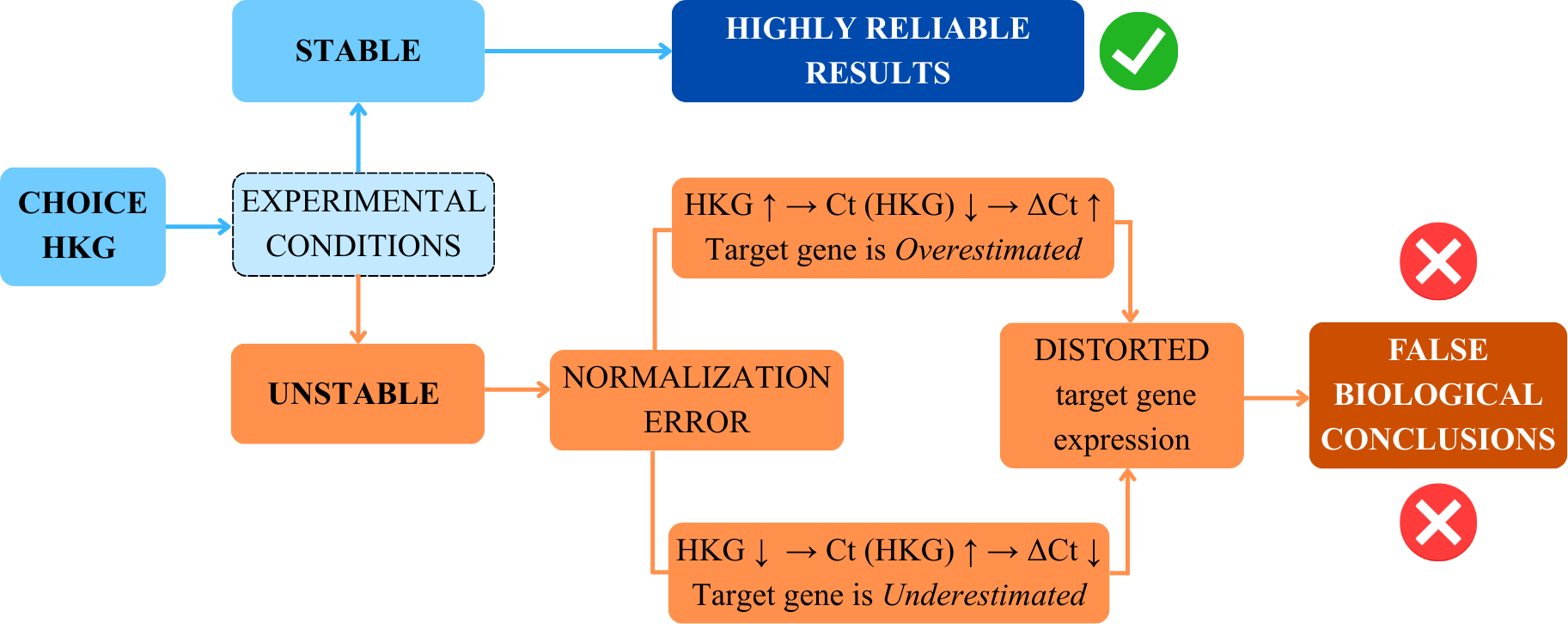
Reference gene stability directly dictates the precision, validity, and biological interpretability of gene expression profiling. Normalizing datasets against unverified, unstable internal controls introduces severe mathematical bias and systematic error (Figure 2)59. The updated MIQE 2.0 guidelines explicitly assert that qPCR datasets normalized against unvalidated reference genes cannot be considered analytically valid22.
Conceptual framework illustrating how reference gene instability introduces mathematical distortion and flawed biological interpretations. Pathway Description and Mathematical Distortion Mechanisms: This flowchart depicts the cascading consequences of housekeeping gene (HKG) selection on quantitative target gene evaluation in RT-qPCR assays. Following exposure to specific experimental conditions (e.g., differentiation, hypoxia, or cytokine challenge), candidate reference transcripts bifurcate into stable or unstable trajectories: Stable Trajectory (Top Path): Validated reference genes retain constant transcript abundance across experimental groups, yielding accurate ΔCt calculations and highly reliable, biologically valid conclusions (indicated by the green checkmark). Unstable Trajectory (Bottom Path): When an unvalidated, condition-responsive gene is selected, biological modulation causes normalization errors:
Across diverse MSC sources (adipose tissue, bone marrow, umbilical cord matrix), conventional HKGs such as GAPDH, ACTB, and PGK1 frequently display pronounced expression instability, whereas non-traditional candidates such as PPIA, YWHAZ, TBP, RPL13A, RPLP0, 18S rRNA, or RRP1 provide superior stability in specific biological contexts (Table 1). External factors—including tissue harvest site12, donor characteristics10, pericellular hypoxia43, culture media shifts (FBS to SFM/XFM)13, inflammatory activation, serum starvation48, and 3D scaffold encapsulation50—profoundly alter basal HKG transcription. Choosing an inappropriate reference gene can artificially amplify or dampen apparent expression differences in target genes. In MSC differentiation assays, sub-optimal reference gene selection can entirely mask lineage-specific induction markers or, conversely, create artifactual differences in differentiation efficiency60. In severe instances, improper normalization can invert biological conclusions. For example, Casas et al. (2022) demonstrated that standardizing stroke-related NOX4 expression against different HKGs generated contradictory conclusions regarding whether the target transcript was significantly upregulated or downregulated59. In cytokine-primed MSCs, normalizing against ACTB completely obscured the upregulation of the key immunosuppressive enzyme indoleamine 2,3-dioxygenase (IDO), whereas stable reference genes revealed robust induction. Such discrepancies are especially detrimental in quantitative potency assays, where misquantifying immunomodulatory transcripts can compromise therapeutic efficacy and product characterization.
At the bioprocessing and translational scale, reference gene instability increases experimental variance, generating false-positive or false-negative readouts that directly impact cell therapy release criteria13. Ragni et al. (2024) demonstrated that when comparing AD-MSCs expanded in SFM versus FBS, unstable ACTB expression falsely indicated an upregulation of the proinflammatory chemokine CCL5 in SFM products; conversely, normalization against the stable reference gene TBP demonstrated that CCL5 transcription was unchanged or slightly downregulated13. Similarly, during immunological evaluations of MSCs encapsulated in 3D biomaterials or subjected to inflammatory challenge, ACTB normalization severely skewed perceived immune-modulating potency50,61.
In commercial cell manufacturing and clinical translation, MSC products must adhere strictly to GMP regulations. Regulatory agencies, including the US Food and Drug Administration (FDA) and the European Medicines Agency (EMA), mandate validated quantitative potency testing prior to lot release. Within these release assays, reference genes represent an indispensable component of the analytical validation framework, ensuring assay accuracy, linearity, and precision62. Normalizing against unvalidated reference genes can cause release metrics to fall artificially outside predefined acceptance ranges. This introduces substantial operational risks: high-quality cell batches may be erroneously rejected due to normalization artifacts—resulting in substantial economic loss—or compromised cell batches may be mistakenly released, posing direct clinical risks to patients.
Recommendations and Emerging Standardization Strategies
Methodological Recommendations Aligned with MIQE 2.0
Inter-laboratory variability in MSC research remains substantial due to divergent tissue isolation techniques, expansion protocols, cryopreservation methods, oxygen concentrations, and culture media lots, all of which alter baseline gene expression63. For instance, transitioning from FBS-based media to SFM/XFM bioprocesses directly shifts reference gene stability hierarchies13. Although regulatory authorities mandate potency testing for MSC product release64, specific standardized panels for reference gene selection are not formally codified in GMP or FDA guidance documents. Consequently, reference gene validation must be treated as a facility- and protocol-specific process, precluding the direct extrapolation of HKG sets across different laboratories or distinct biomanufacturing runs. Each facility must empirically validate candidate reference genes upon establishing or modifying production parameters, locking validated panels into formal SOPs to preserve batch-to-batch consistency.
Assay reproducibility represents the cornerstone of reliable quantitative molecular testing. In this regard, inter-laboratory standardization is not merely recommended—it is essential. The original MIQE guidelines served as the technical foundation for the international standard ISO 20395:201965, demonstrating the universal relevance of these validation frameworks. The updated MIQE 2.0 consensus statement (published in 2025) introduces several critical enhancements3:
-
Provides comprehensive specifications for inter-laboratory comparability, cross-platform instrument calibration, and transparent metric reporting.
-
Mandates empirical validation and confidence intervals rather than reliance on nominal Cq values.
-
Enforces the routine inclusion of rigorous negative controls (no-template controls [NTC] and no-reverse-transcription controls [NRTC]) and strongly recommends exogenous RNA spike-in controls to monitor RNA recovery, reverse transcription inhibition, and PCR amplification efficiency.
-
Explicitly requires the geometric mean of multiple experimentally validated reference genes for normalization, strictly forbidding the use of single unvalidated housekeeping genes.
To facilitate preselection, public expression databases such as Genevestigator—which curates thousands of high-quality transcriptomic datasets—provide empirical confirmation that no mammalian transcript is universally stable across all physiological settings66. The "Reference Gene Selection" tool within Genevestigator enables researchers to query specific biological contexts and shortlist stable candidate genes67. In practice, researchers should design a candidate panel comprising 8–12 genes representing diverse, non-overlapping functional pathways to prevent co-regulation bias. Initial selection can be informed by whole-transcriptome RNA-seq datasets (prioritizing genes with low standard deviation and minimal CV across replicates) or prior validation studies in comparable cell types43. Following candidate selection, MSCs should be cultured under representative experimental conditions, and total RNA must be extracted while ensuring high purity (A/A ~ 2.0; A/A > 1.8) and structural integrity (RNA Integrity Number [RIN] ≥ 7.0), as partially degraded RNA introduces substantial normalization artifacts. Furthermore, primer amplification efficiency must be rigorously determined using multi-point serial cDNA dilutions (optimal slope −3.32, efficiency 90–110%, R > 0.99), primer specificity must be confirmed via single-peak melting curve analysis or gel electrophoresis, and all reactions should be performed in technical and biological triplicate12,68,69. Finally, stability should be evaluated using a multi-algorithmic consensus strategy (geNorm, NormFinder, BestKeeper, comparative ΔC, and RefFinder) to identify the optimal number of reference genes (typically 2 to 3) for geometric mean normalization (Figure 3, Table 3)66.
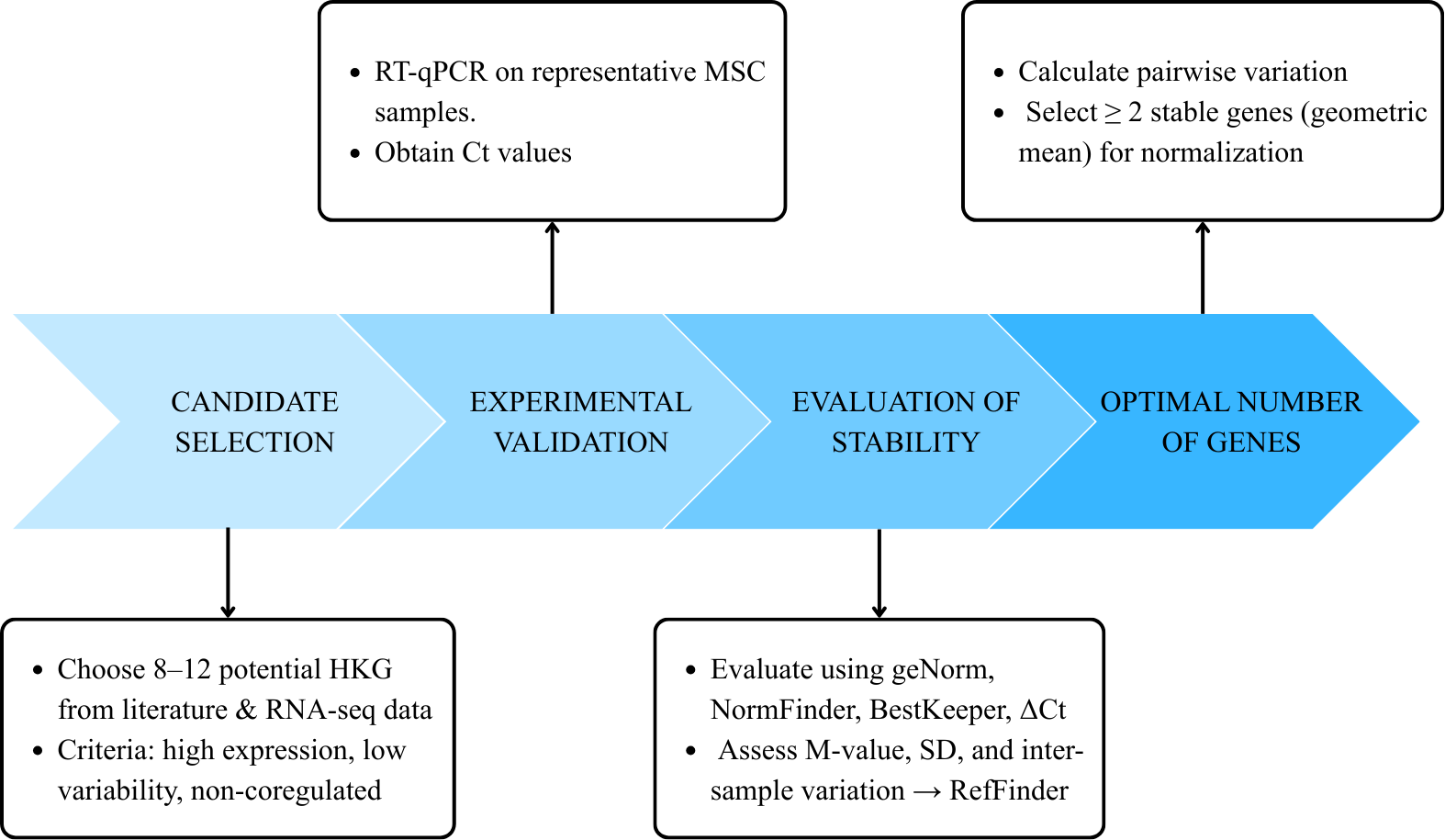
Standardized four-phase workflow for reference gene selection and experimental validation in MSC research. Methodological Workflow and Decision Architecture: This multi-stage schematic outlines a systematic, guideline-compliant protocol (conforming to MIQE 2.0 recommendations) for identifying and validating stable internal reference controls for gene expression profiling in mesenchymal stem cells (MSCs): Phase 1: Candidate Selection: Pre-screen 8–12 candidate reference genes from curated literature databases and public RNA-seq datasets (e.g., Genevestigator). Selection criteria mandate moderate-to-high transcript abundance (Ct 18–28), low baseline coefficient of variation (CV < 20%), and deliberate distribution across non-overlapping functional and metabolic pathways to eliminate co-regulation artifacts. Phase 2: Experimental Validation: Culture MSCs under experimental conditions precisely mirroring the study design. Extract high-purity, intact total RNA (RIN ≥ 7.0), verify primer specificity (single melt curve peak), assess PCR amplification efficiency via standard curves (90–110%), and execute RT-qPCR across biological and technical triplicates to generate raw quantification cycle (Ct/Cq) values. Phase 3: Evaluation of Stability: Perform statistical evaluation across candidate genes using established mathematical algorithms—including geNorm (stability measure
Alongside gene validation, investigators must comprehensively document experimental parameters in accordance with the MIQE 2.0 reporting checklist—including primer sequences, amplification efficiencies, C distributions, sample cohort sizes, biological replicates, and algorithmic stability values—thereby providing full transparency for peer reviewers and academic readers3.
Emerging Approaches: Small RNA Reference Panels and Machine Learning
The establishment of robust reference standards is gaining rapid traction as MSC applications expand from whole-cell therapy toward cell-free biologics, particularly microRNAs (miRNAs) packaged within extracellular vesicles (EVs). Because traditional mRNA-based HKGs are largely absent or highly fragmented within EV cargo, endogenous miRNAs have emerged as candidate reference controls for normalizing EV molecular content. However, widely used small RNA controls (e.g., U6 snRNA) are susceptible to processing variability and do not accurately reflect EV packaging dynamics. Profiling of adipose-derived MSC-EVs revealed that miR-16-5p and miR-23a-3p were stably and consistently detected, whereas let-7a-5p, miR-425-5p, and U6 snRNA exhibited substantial variability70. Similarly, in amniotic fluid MSC-EVs, miR-101-3p and miR-22-5p demonstrated high stability, while miR-423-5p and U6 snRNA showed severe expression fluctuations71. These collective findings emphasize that U6 snRNA should be avoided in quantitative EV-miRNA studies due to its high vulnerability to bioprocessing artifacts. In specialized differentiation systems, multi-miRNA panels are increasingly necessary: for example, the combination of miR-191-5p and let-7a-5p provides optimal normalization during BM-MSC chondrogenesis72, while miR-103a-3p and miR-22-5p display cross-source stability across bone marrow, adipose, and chondrocyte-derived EVs73.
Concurrently, in silico bioinformatic pipelines and artificial intelligence (AI) methodologies are reshaping reference gene selection. Algorithmic tools such as HouseKeepR automate the retrieval and meta-analysis of public transcriptomic repositories, ranking candidate genes in an unbiased, context-specific manner59. This data-driven approach overcomes the inherent biases of literature convention. Furthermore, advanced machine learning architectures—including Random Forest, Support Vector Machines (SVM), and deep neural networks—are increasingly deployed to parse high-throughput multi-omics data (transcriptomics, epigenomics, and proteomics) to identify stable, context-tailored reference networks74. These algorithms evaluate not only mean expression and variance but also gene co-expression networks, topological connectivity, tissue specificity, and experimental covariates1. As curated biomedical repositories expand and AI-driven feature selection matures75,76, machine learning–assisted reference gene selection represents a transformative strategy for standardizing MSC research and large-scale clinical biomanufacturing.
Conclusion
The selection of housekeeping genes in mesenchymal stem cell research cannot be addressed through simple, one-size-fits-all assumptions. MSCs display remarkable biological plasticity, undergoing profound transcriptomic rewiring during multilineage differentiation, metabolic reprogramming, hypoxic adaptation, inflammatory licensing, mechanical stimulation, and extended ex vivo expansion. This intrinsic responsiveness systematically disrupts the transcriptional stability of traditional reference genes such as GAPDH and ACTB. Empirical evidence firmly establishes that no universal reference gene exists across all MSC experimental conditions. Accurate, reproducible normalization requires a context-specific validation strategy that merges rigorous mathematical algorithms with sound biological rationale. Failing to validate reference genes risks generating distorted expression metrics, false-positive or false-negative findings, and contradictory conclusions in potency and translational assays. Integrating multi-gene normalization panels, adhering strictly to MIQE 2.0 reporting standards, and leveraging RNA-seq preselection and machine learning models provide a robust methodological foundation to ensure experimental rigor, reproducibility, and therapeutic translatability in MSC biology.
Abbreviations
18S rRNA: 18S ribosomal RNA; ACTB: Beta-actin; AD-MSCs / ASCs: Adipose-derived mesenchymal stem/stromal cells; AI: Artificial intelligence; B2M: Beta-2-microglobulin; BM-MSCs / BMSCs: Bone marrow–derived mesenchymal stem/stromal cells; C / C: Quantification cycle / Cycle threshold; CV: Coefficient of variation; ΔC: Delta cycle threshold; ECM: Extracellular matrix; EF1A: Eukaryotic translation elongation factor 1 alpha 1; EMA: European Medicines Agency; EVs: Extracellular vesicles; FBS: Fetal bovine serum; FDA: Food and Drug Administration; GAPDH: Glyceraldehyde-3-phosphate dehydrogenase; GMP: Good Manufacturing Practice; hAM-MSCs / hAMSCs: Human amniotic membrane–derived mesenchymal stem/stromal cells; HIF-1α: Hypoxia-inducible factor 1 alpha; HKGs: Housekeeping genes; hPL: Human platelet lysate; HPRT1: Hypoxanthine phosphoribosyltransferase 1; HRE: Hypoxia response element; HSP90AA1: Heat shock protein 90 alpha family class A member 1; IDO: Indoleamine 2,3-dioxygenase; IFN-γ: Interferon gamma; IL-1β: Interleukin 1 beta; ISCT: International Society for Cell & Gene Therapy; miRNA: MicroRNA; MIQE: Minimum Information for Publication of Quantitative Real-Time PCR Experiments; ML: Machine learning; MSCs: Mesenchymal stem/stromal cells; NRTC: No-reverse-transcription control; NTC: No-template control; PGK1: Phosphoglycerate kinase 1; POLR2A: RNA polymerase II subunit A; PPIA: Peptidylprolyl isomerase A (Cyclophilin A); QC: Quality control; RIN: RNA integrity number; RNA-seq: RNA sequencing; RPL13A: Ribosomal protein L13a; RPLP0: Ribosomal protein lateral stalk subunit P0; RPS13: Ribosomal protein S13; RPS17: Ribosomal protein S17; RRP1: Ribosomal RNA processing 1; RT-qPCR: Reverse transcription quantitative real-time polymerase chain reaction; SASPs: Senescence-associated secretory phenotypes; SD: Standard deviation; SFM: Serum-free medium; SOP: Standard operating procedure; SV: Stability value; TBP: TATA-box binding protein; TNF-α: Tumor necrosis factor alpha; TUBA1B: Tubulin alpha 1b; UBB: Ubiquitin B; UBC: Ubiquitin C; UC-MSCs: Umbilical cord–derived mesenchymal stem/stromal cells; XFM: Xeno-free medium; YWHAZ: Tyrosine 3-monooxygenase/tryptophan 5-monooxygenase activation protein zeta.
Acknowledgments
None.
Author’s contributions
T.K.N. Nguyen, N.T.T. Nguyen, and A.M. Nguyen conducted the literature investigation, performed data curation, and prepared the original manuscript draft. K.V.T. Nguyen and K.D. Bui supported formal comparative analyses and contributed to critical manuscript editing. P.D. Huynh conceptualized and supervised the study, oversaw methodology and project administration, and critically revised and finalized the manuscript. All authors read and approved the final manuscript.
Funding
This research was funded by Vietnam National University Ho Chi Minh City (VNU-HCM) under grant number C2026-18-27.
Availability of data and materials
None.
Ethics approval and consent to participate
None.
Consent for publication
None.
Declaration of generative AI and AI-assisted technologies in the writing process
During the preparation of this manuscript, the authors utilized ChatGPT and Grammarly solely for English language editing and stylistic refinement. Following the use of these tools, the authors thoroughly reviewed, validated, and edited the text to ensure factual accuracy and scientific rigor. The authors take full institutional and intellectual responsibility for the contents of this publication, and all final interpretations and conclusions were determined entirely by the authors.
Competing interests
The authors declare that they have no competing interests.