


Preoperative Serum Interleukin-6-Based Prediction Model for Early Allograft Dysfunction in Living Donor Liver Transplantation
- Mansoura University, Mansoura, Egypt
Abstract
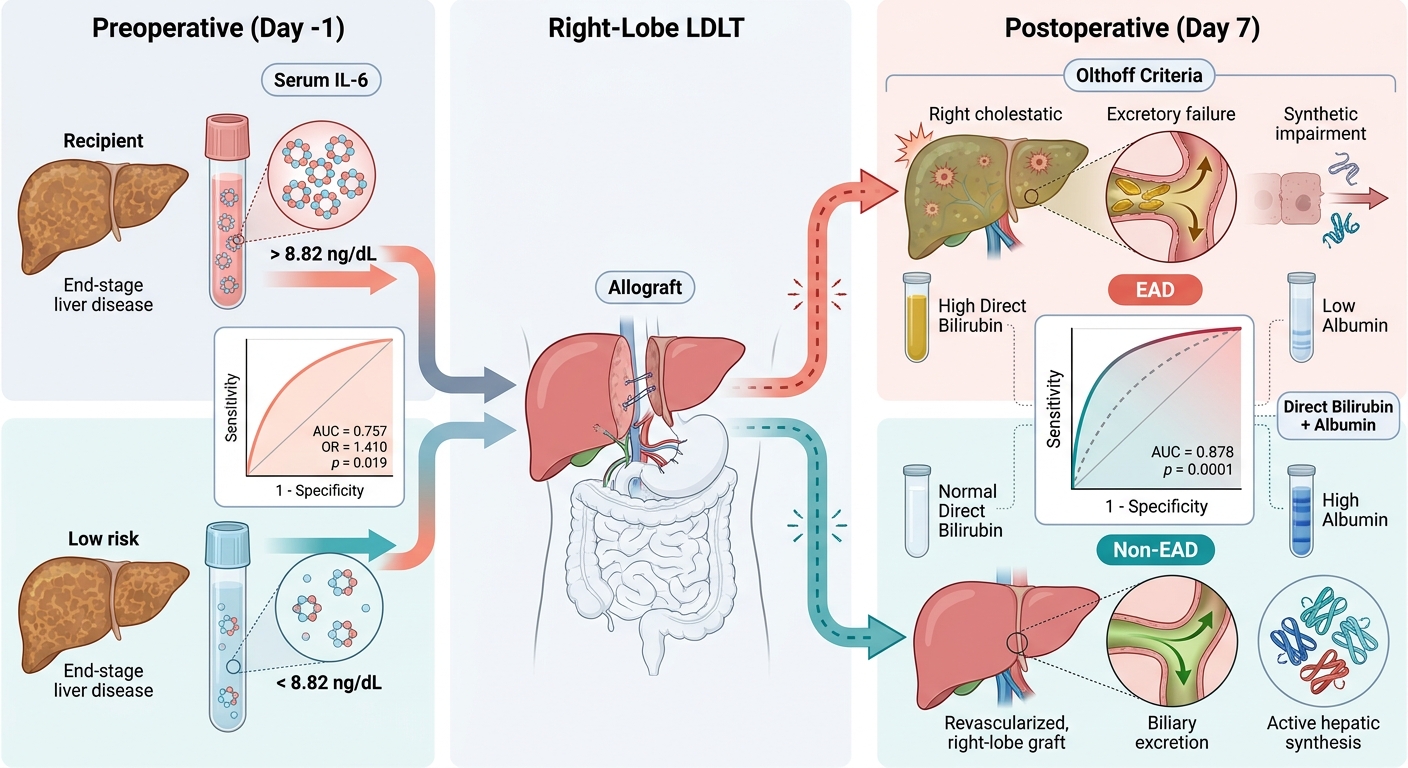
Background: Early allograft dysfunction (EAD) following living donor liver transplantation (LDLT) is strongly associated with graft loss and recipient mortality. Identifying accurate, noninvasive pre- and early postoperative biomarkers is crucial for timely risk stratification. This study aimed to determine the predictive utility of preoperative and postoperative serum interleukin-6 (IL-6) levels, in conjunction with routine biochemical and hematological indices, for the development of EAD in adult LDLT recipients.
Methods: Forty adult patients undergoing LDLT were prospectively enrolled and categorized into non-EAD (NEAD, n = 24) and EAD (n = 16) groups based on standardized Olthoff criteria. Serum IL-6 concentrations and panel parameters—including liver transaminases, bilirubin fractions, albumin, gamma-glutamyl transferase (GGT), and complete blood counts—were quantified on the day prior to surgery (Pre) and on postoperative day 7 (POD-7). Receiver operating characteristic (ROC) curve analysis and binary logistic regression were performed to establish prediction models, with internal validation assessed using 1,000 bootstrap resamples and calibration evaluated via the Hosmer-Lemeshow test.
Results: Serum IL-6 levels were significantly elevated in the EAD cohort compared to the NEAD cohort both preoperatively (10.67 ± 2.77 vs. 8.01 ± 2.98 ng/dL, p = 0.007) and on POD-7 (13.10 ± 4.45 vs. 10.28 ± 3.00 ng/dL, p = 0.034), yielding areas under the curve (AUC) of 0.757 and 0.718, respectively. In univariable logistic regression, preoperative IL-6 was an independent predictor of EAD (odds ratio [OR] = 1.410, 95% CI: 1.058–1.879, p = 0.019), generating a standalone preoperative prediction model [Model 1: Logit(P) = 0.343 × Pre-IL-6 − 3.575] with 75.0% sensitivity, 75.0% specificity, an apparent AUC of 0.7565, and an optimism-corrected AUC of 0.7568. A multivariable postoperative model combining POD-7 direct bilirubin (DB) and albumin (Alb) [Model 2: Logit(P) = 0.403 × POD-7 DB − 4.175 × POD-7 Alb + 10.680] demonstrated high discriminative capacity, with 87.5% sensitivity, 87.5% specificity, an apparent AUC of 0.8776, and an optimism-corrected AUC of 0.8767. Both models showed satisfactory calibration (Hosmer-Lemeshow p > 0.05).
Conclusion: Preoperative serum IL-6 serves as an effective, independent early biomarker for predicting EAD prior to LDLT, offering actionable clinical utility for preemptive donor-recipient risk mitigation. While the postoperative model incorporating POD-7 direct bilirubin and albumin achieved higher statistical discrimination, the preoperative IL-6 model provides distinct clinical value before surgical incision. Furthermore, incorporating postoperative serum albumin into early risk assessments represents a valuable adjunct to existing diagnostic paradigms.